


The FCA’s consultation on fee disclosure, CP26/24, closed on 21 August. It covered what firms must tell you about charges, what happens to the interest on your cash, and how disclosure should work now that investors increasingly use AI to research their options. SCM’s submission told the regulator what needs fixing, and none of it is difficult. Here is what each fix would be worth to you, and how to establish your own position before the regulator or industry gets round to it.
Most people with a substantial portfolio could not tell you, to the nearest thousand pounds, what it cost them last year.
That is not carelessness. It is design. The information exists – your platform knows it, your fund managers know it, your adviser knows it – but it is rarely assembled in one place, in one format, at one moment when you could make meaningful comparisons.
The FCA has been consulting on changing that. SCM’s 18-page submission supports most of the proposals, but we asked for three additional things to improve transparency, understanding and customer outcomes. None requires new data. None requires new calculations. All three could be done inside the timetable the regulator has already set.
Step one: one price, in one format, in one place
The new rules will require firms to show what you pay in pounds and pence rather than percentages alone. Good. What they will not require is that everyone shows it the same way, in the same place.
So you will still not be able to hold two providers side by side and see which is better value. The regulator concedes this in its own cost-benefit analysis: consumers, it says, “may face a burden in reaching the total cost of investing figure on their own, through adding together the breakdown of costs provided by firms.”
Since 2012, through our True & Fair Campaign, we have been proposing a Fee Label: seven fields, a fixed order, a fixed place, shown before you commit, and published in a machine-readable format for comparison tools. Personalised to your amount and shown on a common £10,000 basis, so two providers can be compared. It seems absurd to us that you can see every ingredient in a bar of chocolate, but not every charge on your investments and pensions.
“A nutrition label does not dictate the recipe. It tells you what is inside, the same way on every packet.”
It is not a dense document, and prescribes nothing about how a firm explains itself, designs its site, or educates its clients. It prescribes the price, and where to find it.

Step two: stop leaving pensions out
This is the one that should trouble anyone. At paragraph 4.11 of the consultation, the FCA proposes to keep things exactly as they are for pensions: no requirement to tell you, after the event, what your pension actually cost you.
Pensions are the largest, longest-held and most cost-sensitive assets most people will ever own.
Compounding means charges do their greatest damage over precisely the longest horizons. Under these proposals, you would be told the pounds-and-pence cost of a £10,000 ISA, not the cost of a £300,000 pension.
In our submission, we have asked the FCA either to bring pensions into the new regime or to commit publicly to a review date for the existing pension disclosure rules. Not a vague intention – a date.
Step three: say what happens to the cash
There is a charge on your account that never appears on the fee card because, technically, it is not a charge.
Cash sitting in your account earns interest. Bank Rate is 3.75%. Across the largest UK platforms, published rates in August 2026 run from under 1% to around 2.8%, depending on balance and wrapper. The difference stays with the platform. On the lowest tiers, that can be close to three-quarters of the interest – in some cases more than the platform charges to manage the investments themselves.
If you hold £50,000 in cash across an ISA and a SIPP during a period of market uncertainty, the gap between a 1% payer and a 2.8% payer is £900 a year. Nobody sends you a statement for it, because nothing was taken. It simply was not passed on.
The FCA is right to codify a ban on “double-dipping” – charging a fee on your cash while also keeping the interest. We supported it. We also asked for three additions: cash terms on the face of the Fee Label; disclosure of how much interest the firm retains, not merely the rate it chooses to pay; and a rolling 12-month rate history, so the number can be checked rather than taken on trust.
What the three steps are actually worth
Costs compound in exactly the way returns do, and over a long holding period the effect is not marginal.
Take a portfolio growing at 5% a year before costs, held for 20 years. Compare an all-in cost of 0.85% with one of 2.00%:
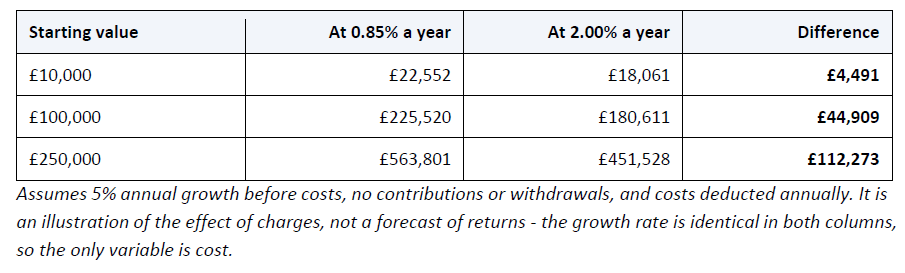
1.15 percentage points — that is the difference between a competitively priced portfolio and an averagely priced one – and over 20 years it costs you almost exactly a fifth of everything you would otherwise have ended up with. On £250,000, that is more than £112,000.
If you are not an SCM client, here are five tips in 10 minutes to help you know your true costs:
- Total your platform or service charge for the last 12 months, in pounds. Not the headline rate – the amount actually taken.
- Add the ongoing charges of everything you hold. The OCF is on every factsheet. Weight it by how much you hold in each.
- Add explicit transaction costs and any performance fees. These are frequently the ones people have never seen.
- Find the interest rate paid on your cash – usually under Rates and Charges, rarely on the dashboard – and check which tier you are in. Multiply your balance by it and compare it to 3.75%.
- Divide the total by your portfolio value. That figure is your all-in cost, and it is the number that we believe should be on all fee pages.
Note how long that took. Cost you cannot locate in ten minutes is cost that is, in effect, hidden from you, and you were never going to compare.
Where SCM Direct stands
We should declare our interest, and we did so in the submission itself. A rule requiring every firm to publish an all-in cost in a standard format would cost us very little, because we already publish ours in full and in one place before anyone invests. We always have. This level of simplified transparency was a key principle behind our Founders – Alan and Gina Miller – starting SCM Direct. They also hold their own money in the same portfolios as clients, on the same terms and the same fees.
Consider the other side of that. The firms for whom a standard price label would be most expensive are, by definition, the firms whose prices are hardest to find and add up today. That is not a coincidence. It is the whole argument.
We have campaigned on this since 2012, through the True & Fair Campaign, funded entirely by our founders with no industry backing. The three steps above are what we have asked the FCA for.
We would rather the whole industry adopted them than that we were unusual for having already done so.
Read our full FCA consultation submission here
See exactly what fees we charge
The SCM Direct Team
Capital at risk. The value of investments can go down as well as up and you may get back less than you invest. Past performance is not a guide to future returns. The illustration above assumes 5% annual growth before costs and is not a forecast. The quoted interest rates are as published by providers in August 2026 and are subject to change. This article is general information and does not constitute personal financial advice or a recommendation. If you are unsure what is suitable for you, seek regulated advice. SCM Direct is a trading name of SCM Private LLP, authorised and regulated by the Financial Conduct Authority (No. 497525).


