


This blog explores the Great Reset agenda , its three main pillars, and its implications for investment portfolios.
The World Economic Forum (WEF) proposed the Great Reset as a way to build a more sustainable and inclusive global economy after the COVID-19 pandemic. The agenda is centred around three primary objectives:
- Steer markets toward fairer outcomes: This pillar emphasises the need for economic policies that foster equality, transparency, and inclusive growth. Proposed measures include tax reforms, regulatory changes, and enhanced social safety nets.
- Ensure investments advance shared goals: The second pillar encourages the alignment of investments with long-term objectives, such as sustainable development and societal well-being. It advocates for the integration of environmental, social, and governance (ESG) criteria into investment decision-making processes.
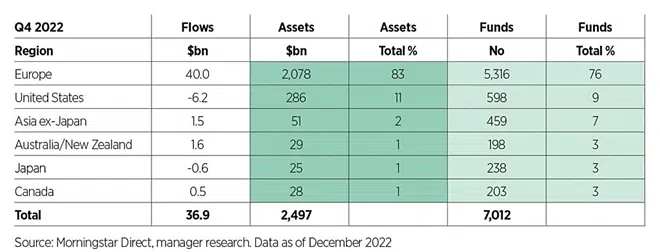
The reality is that there is widespread evidence of greenwashing, with SCM Direct being one of the leading voices, exposing firms and funds – see Does ESG stand for Extra Strong Greenwashing, L&G? – SCM Direct. This is against the backdrop of ESG funds growing significantly in recent years, particularly in Europe:
- Harness the innovations of the Fourth Industrial Revolution: The third pillar focuses on leveraging cutting-edge technologies like artificial intelligence, automation, and biotechnology to address global challenges and create new opportunities for economic growth.
Goldman Sachs recently estimated that 300 million full-time jobs around the world could be automated by artificial intelligence, predicting that 18% of work globally could be computerised, with the effects felt more deeply in advanced economies than emerging markets.
In the United States and Europe, approximately two-thirds of current jobs “are exposed to some degree of AI automation,” and up to a quarter of all work could be done by AI completely. They estimate the impact of AI could lead to a 7% annual boost to global GDP over a 10-year period.
However, when we asked the AI platform Bard for their forecast, it said “Overall, the impact of AI on the economy is expected to be positive, with GDP growth increasing by an average of 1.2% per year between 2017 and 2030.”
Whether it’s cutting-edge AI or biotech or other investing themes, as the chart below shows, the returns are often greater when investing in more traditional companies that utilise new technology to improve efficiencies, rather than specialist tech companies themselves:

Implementation
Several governments, including the European Union (EU), Canada, and Japan, have taken significant steps to implement various aspects of this new economic and social order. The EU’s Green Deal, which aims to transform Europe into a carbon-neutral economy by 2050, aligns closely with the WEF’s sustainability goals. The Next Generation EU recovery plan, with its €750 billion funding package, also advances the Great Reset by prioritising investments in green technologies, digital infrastructure, and social cohesion. Furthermore, the EU has been a vocal advocate of corporate social responsibility in the form of ‘stakeholder capitalism.’
Canada is another leader in adopting the Great Reset. Prime Minister Justin Trudeau has explicitly endorsed the initiative, committing to “build back better” by focusing on sustainable and inclusive economic growth. Canada’s climate plan, which includes carbon pricing and a commitment to net-zero emissions by 2050, exemplifies its dedication to the cause.
Japan has also been prominent in embracing the principles of the Great Reset. The nation’s ‘Society 5.0’ initiative, which aims to transform society through digital innovation, resonates with the WEF’s call for a Fourth Industrial Revolution. Additionally, Japan has pledged to achieve carbon neutrality by 2050.
In the UK, the government is actively implementing the Great Reset agenda in key areas such as climate change, technology, social inclusion, and stakeholder capitalism. The UK has committed to a legally binding target of net-zero greenhouse gas emissions by 2050, spurring the growth of renewable energy projects and the phasing out of fossil fuels.
The government has also invested in electric vehicle infrastructure and public transportation improvements to reduce emissions. In the area of technology, investments in digital infrastructure, such as broadband expansion and 5G networks, have been prioritised.
Again, according to the Bard AI machine, ‘The UK is on track to meet its 2030 emissions target of 57% below 1990 levels. However, there are still significant challenges to be overcome in order to reach net zero by 2050.
These challenges include:
- Decarbonising the transport sector, which is responsible for a third of the UK’s emissions.
- Reducing emissions from agriculture and land use.
- Removing carbon dioxide from the atmosphere.’
Implications for Investors
1. Focus on ESG investing: The Great Reset emphasises the importance of incorporating ESG criteria into investment decisions.
2.Opportunities in green technologies: The transition to a low-carbon economy is a key component of the Great Reset. As governments and businesses invest in clean energy, electric transportation, and other green technologies, there will be significant opportunities for investors to capitalise on this growing market. Green bonds, renewable energy stocks, and funds focused on sustainable technologies are just a few examples of investment vehicles that can benefit from this shift.
3. Long-term value creation: The Great Reset encourages businesses to prioritise long-term value creation over short-term profit maximisation. This approach may result in more stable, predictable returns for investors, as companies focus on building resilient business models and mitigating risks associated with climate change, social inequality, and other global challenges.
4. Regulatory changes and government support: The Great Reset calls for regulatory changes and increased government support for sustainable development. Investors should be prepared for shifts in policy that may impact specific industries or sectors. For example, carbon pricing and subsidies for clean energy could create new investment opportunities, while increased regulation around data privacy and labour rights may affect the profitability of certain business models.
At SCM, we manage our SCM Ethical Portfolio to combine a high level of diversification with low costs, whilst aiming to capitalise on the opportunities and challenges created by the Great Reset.
For example, our ESG Portfolio invests in the L&G Clean Water UCITS ETF which tracks the performance of the lobal clean water industry, via the Solactive Clean Water Index. The chart below shows that this ETF has outperformed global equities and the global water sector over the past 12 months:
Source: MorningStar
Conclusion
The Great Reset represents a transformative initiative that seeks to build a more sustainable and inclusive global economy in the wake of the COVID-19 pandemic and climate crisis.
Its three pillars, centred on fairer markets, shared goals, and cutting-edge innovation, providing a framework for businesses, governments, and investors to navigate the challenges and opportunities of the post-pandemic world.
At SCM Direct, we are committed to delivering a range of transparent, low-cost, well diversified portfolios including an Ethical Portfolio which provide exposure to the key themes and trends of the Great Reset in a diversified and cost-effective manner.
Capital at Risk.
The value of investments can go down in value as well as up, so you could get back less than you invest. It is therefore important that you understand the past performance is not a guide to future returns. SCM Private does not give personal advice based on your circumstances. We aim to provide investors with understandable information so they can make fully informed decisions. If you are unsure about the suitability of our investment portfolios, please contact an independent financial adviser. SCM Direct is a trading name of SCM Private LLP which is authorised and regulated by the Financial Conduct Authority to conduct investment business No. 497525. SCM Private LLP is a limited liability partnership registered in England and Wales. No. OC342778


