


The UK Investment Industry is largely still denying investors the basic consumer right of knowing how much they are truly paying, with some providers claiming transaction costs are magically negative.
One of the principal rules that the regulator, the FCA applies to regulated firms is COBS 4.2 Fair, clear and not misleading communications1 that a ‘firm must ensure that a communication or a financial promotion is fair, clear and not misleading’.
Why then are the FCA seemingly allowing so many companies to ignore this rule and report to investors that their products have negative transaction costs – which may be possible in the short term, but almost impossible in the timeline for most investors, which is over the medium to long term?
Such disclosures make the Total Cost of Investing data on which investors rely on, unclear, unfair, and totally misleading.
When investors buy a portfolio of funds through an adviser, or manager, or through a platform, investors must have the ability to see the Total Cost of Investing Number prior to purchase. This should include all the costs, not just the fund manager costs, investment platform costs, but also the costs of the fund/s buying and selling the securities annually, be they shares or bonds.
SCM Direct research has found that many of the costs and charges statements from a variety of providers appear misleading because one element, the transaction costs, is seemingly under-estimated by various funds making the Total Cost of Investing Number unreliable and incomparable with other funds.
The FCA has known about this since July 2018 but appears to be ignoring it, saying it related to just ‘A small number are reporting material negative transaction costs’ https://www.fca.org.uk/publication/call-for-input/priips-regulation-initial-experiences-with-the-new-requirements.pdf. In February 20192 the FCA concluded that “asset managers may be communicating with their customers in a manner that is unfair, unclear or misleading and as such, investors can be confused and misled as to how much they are being charged.” And that firms were incorrectly applying various requirements and levies to produce an “artificially reduced transaction cost figure.”
In June 20193 the FCA wrote to CEOs saying ‘You should be particularly alert to the need to disclose all transaction and incidental costs and charges to customers. These include implicit transaction costs and performance fees. We also remind you that all communications to customers about their MiFID business must be fair, clear and not misleading.’.
Due to the lack of regulatory rigour or enforcement action on named firms by the FCA with regards such costs, the situation has worsened.
SCM Direct found that contrary to the FCA’s 2018 findings, the percentage of funds reporting negative transaction costs is not insignificant at all.
SCM Direct analysed 1,150 London Listed ETFs and found that 15% of these (178) were showing transaction costs of less than zero.
Of these funds, about 2/3 belong to BlackRock/iShares, indicating that the methods used by BlackRock/iShares appears different to other groups. For example, the FTSE 250 ETFs of HSBC, Vanguard, Xtrackers and Invesco all record a range of 0.1% to 0.2% per annum for such costs, but the iShares FTSE 250 ETF reports transaction costs of -0.07% per annum.
Similarly, the FTSE 100 ETFs of HSBC, Invesco, UBS, Xtrackers, Vanguard and Lyxor FTSE all record a range of 0 to 0.23% per annum for such costs but for iShares it is recorded as -0.13% per annum.
Within the 178 funds, the 10 funds with the most unusual (i.e., negative) transaction costs were:

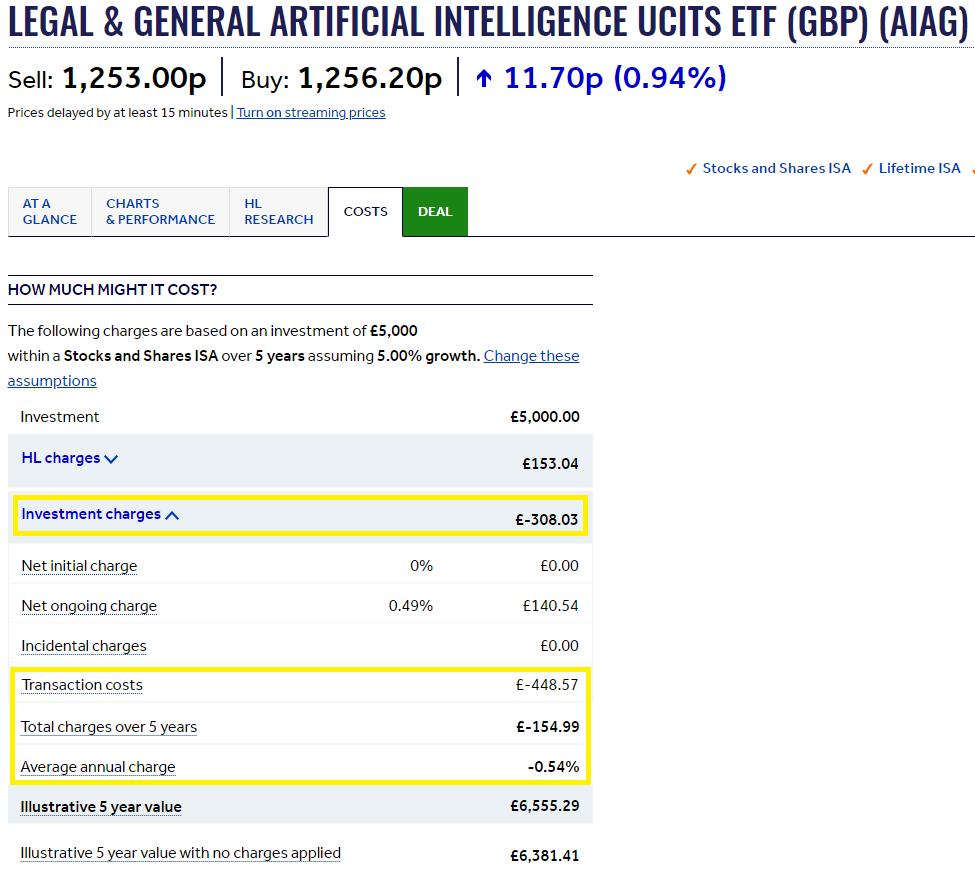
Surely, it cannot cost the L&G Artificial Intelligence Fund -1.55% per annum to buy and sell its index constituents? Because of this highly unusual figure, anyone looking to buy this fund on the Hargreaves platform will be told that the Total Cost of Investing Number – paying Hargreaves its platform fee + the cost of running the fund + the cost of transactions = -0.55% pa!
In fact, the fund charges 0.49% per annum, but has underperformed its index by c. 0.44% since it started, indicating the impact of transaction costs maybe close to 0, but it is not anywhere near -1.55% per annum otherwise the fund would have beaten its index by close to 1% per annum!
One might think that some firms have realised they can (legally) select/create a method that ends up in negative transaction costs, thereby making their product appear cheaper than almost identical alternative products but of course, but we could not possibly say that.

Hargreaves recently told the Sunday Times4 in response to this, that ‘there was an element of “cost slippage” (the difference between the mid-market price at the time a trade is sent to the market and the execution price of the trade). It is possible for the slippage cost to be negative, for example, when buying an asset the price when the trade order is made might be higher than the price paid. “It might be counterintuitive to show negative transaction costs, but the rules and guidance are clear that this is the methodology that must be followed,” the spokesman said.
Hmmm, I wonder how the Hargreaves spokesman thinks this meets either the Clear, Fair and Not Misleading Rule or the Treating Customers Fairly (TCF) rule? To be fair Hargreaves are better than most as they do show the Total Cost of Investing, but as I was taught, GIGO – Garbage In, Garbage Out.
Similarly, SCM Direct analysed 910 UK registered, OEICS that were classified by the Investment Association, and which managed at least £500m. SCM found that 9% (83 funds) of these reported negative transaction costs.

Legal & General
Interestingly, the giant £2.2bn L&G UK property fund that invests in illiquid assets (property) says transaction costs are -0.55% per annum even though as far back as 2018 ‘The FCA added that a handful of investment companies were reporting negative transaction costs for illiquid assets even though this should not be possible.’
L&G also have an FTSE 100 tracker unit trusts which reports negative transaction costs so no overall fund charges! It shows that its 0.1% charge is more than offset by a -0.16% transaction cost, so overall it costs are less than nothing. If this really were the case you would expect the fund to beat its index, it does not. It underperforms it by 0.18% per annum.

Once you added these negative transaction costs to the reported ongoing costs, SCM Direct found many funds reported overall costs of less than zero!

Faced with this evidence, it is time that fund groups and the FCA looked at this again and tried to ensure that communications of costs and charges more closely reflect real costs and charges. Of course, there may be times because of the time between when an order to trade a security is communicated and executed, that the market moves in your favour and thus you trade for no cost, but such examples will inevitably sum to zero over the medium term. So surely showing significant negative transaction costs is unlikely to be a good guide to future transaction costs?
Why cannot fund groups use their intelligence and integrity to use an alternative methodology that more closely represents reality or are such qualities missing in action in these groups? If they can’t put their own houses in order, the FCA must mandate a methodology to ensure rules aimed at enhancing consumer protection are working.
Links:
- https://www.handbook.fca.org.uk/handbook/COBS/4/2.html
- https://www.fca.org.uk/publications/multi-firm-reviews/review-disclosure-costs-asset-managers
- https://www.fca.org.uk/publication/correspondence/portfolio-letter-wealth-managers-stockbrokers.pdf
- https://www.thetimes.co.uk/article/more-than-a-million-investors-overcharged-by-their-fund-manager-59h7cvbk
Capital at Risk.
The value of investments can go down in value as well as up, so you could get back less than you invest.


